Export Vault Data
Export your vault data, including logins and notes, to back up important information or transfer to a new Bitwarden vault. No unencrypted data is transferred over the internet, because data is decrypted locally by the client before exporting.
If you’re adding Bitwarden to a new device and your account is hosted on our cloud servers, you don’t need to create an export. Instead, download Bitwarden on your new device and log in with your existing account.
Unless you use an encrypted export, do not store or send the exported file over insecure channels, like email, and delete the file immediately after use.
Exports can be downloaded in a few formats:
.json(plaintext).csv(plaintext).zip (with attachments)(includes a.jsonfile and your attachments)note.zipexports are currently only available for individual vault data.Export directly to another app with iOS 26+ and Android 10+. The destination app must support the FIDO Credential Exchange Protocol (CXP).
Review example .csv and .json files to decide which format is best for you. We recommend the encrypted .json option for best security and most complete export. Only .json exports include:
Cards
Identities
- note
Passkeys created prior to 2024.3.1 include a counter that increments with each use. If the stored counter does not match what's expected by the service the passkey is being used to log in to, it may reject it, so exports of passkeys of that age should not be used as long-term backups.
No export formats include trash items or Sends. For a complete list of all items and fields included in an individual vault export, check out this .json sample.
Individual vault exports do not include organization-owned data. Only admins, owners, and some custom roles can export organization items via the web app or CLI. Members with Manage collection permission can, however, export data from collections they can access.
To export vault data:
Select Tools.
Select Export:
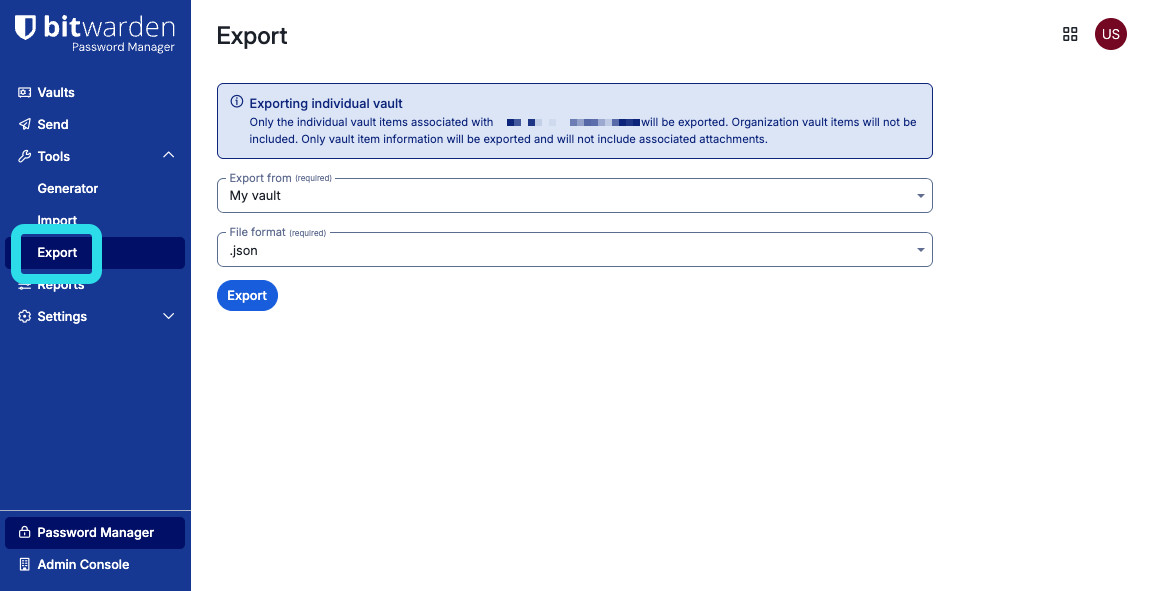
Export items From the Export from dropdown menu, select which data to download:
Select My vault for your individual vault’s items.
Select an organization vault’s name, which will include data from collections where you have Manage collection permission.
Select a File Format:
.json,.csv,.json (Encrypted), or.zip (with attachments)).(Optional) If you choose
.json (Encrypted), select an Export type for the encrypted file:Account restricted: This file can only be imported to the current Bitwarden account that generated the encrypted export file.
warningAccount restricted exports can only be imported to the same account where it originated. Account restricted exports cannot be imported to a different account, including:
An account with the same email on a different geographic or self-hosted server
Another account with the same email address, even if the originating account was deleted
Additionally, rotating your account's encryption key will render an account restricted export impossible to decrypt. If you rotate your account encryption key, replace any old files with new ones that use the new encryption key.
If you wish to import an encrypted
.jsonfile into a different Bitwarden account, generate a Password protected export instead.Password protected: This file can be imported to any Bitwarden account by utilizing the password set during the encrypted export process.
tipSelect to securely generate a unique password for the export. If you do, be sure to save that password in a safe place.
Select Export.
Enter your master password or an email verification code to confirm.

Export files will be saved to the location set by your browser. By default this is typically a Downloads folder, but you can change it within the web browser.
