
Centralised ownership is one half of the Bitwarden architecture that enables full Credential Lifecycle Management. The other, complementary component is the Bitwarden scalable sharing model.
Enterprise password management solutions invariably store credentials and other sensitive data in a secure, encrypted vault.
Where Bitwarden is unique is that the “owner” of the item is the organisation – the business account – itself. This allows for full management of the credential lifecycle from creation to succession and keeps businesses in control of shared credentials, providing several benefits over other vault structures.
Regardless of who created or shared a credential, a business needs to have control of it for reporting, managing access, and data loss prevention.
Why?
Governing bodies require credential auditing for compliance
Reporting and alerts for stored credentials involved in a breach must be kept up to date
When a user leaves the organisation, shared credentials must not be lost or taken with the user
> Without a way for businesses to manage all credentials, they rely on end users to ensure credential health and manage vault item succession plans.
Items in Bitwarden belong to the organisation, not individual employees. This allows for total visibility in reporting, easy management of access, seamless employee transitions, and zero data loss.
How?
All shared items are stored in the organisation vault
This can also apply to unshared items with an enterprise policy
Reporting and access are managed centrally in the vault
No impact on stored items when users transition or collections are removed
The Bitwarden model provides centralised data ownership, enabling full credential lifecycle management:
✅ Reporting and breach monitoring apply to every stored item
✅ Administrator oversight of all shared items
✅ Zero data loss during employee transitions
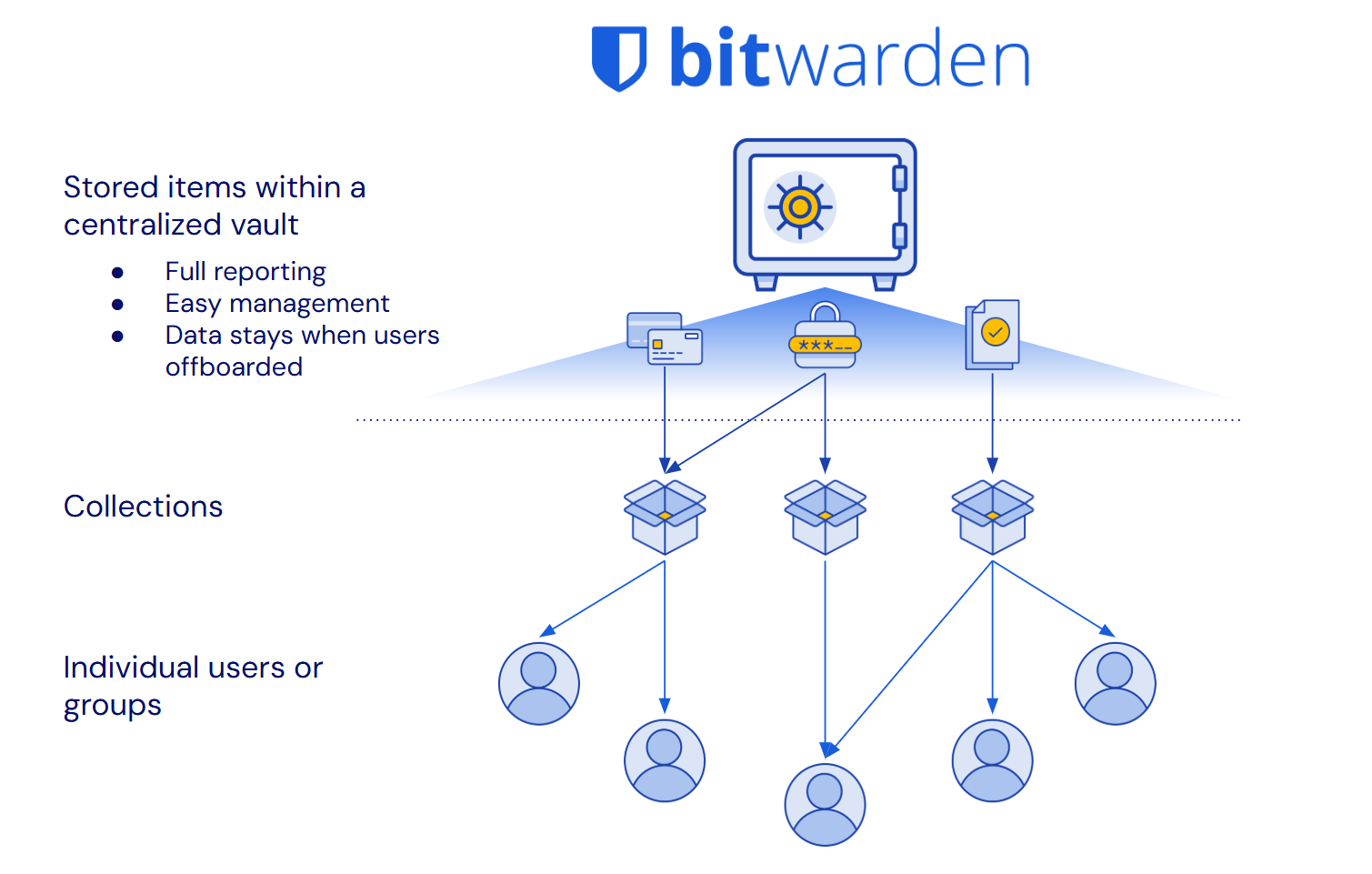
> The Bitwarden vault and all items within it are owned by the organisation. Vault items are independent of user status or assigned collections. Centralised, secure, and built for business management.
Not all password managers were built for the reporting and management needs of businesses. They require blind trust in users to manage credential security.
Relying on users to manage their credentials means:
👎 Incomplete reporting on stored credentials
👎 Interrupted work when employees leave
👎 Items stored outside the control of the business
What happens without centralised organisation ownership?
❌ Unnoticed breached and weak passwords
❌ Business disruption when employees transition
❌ Data loss / necessary recovery procedures
All this results in security gaps, loss of data, and administrative headaches.
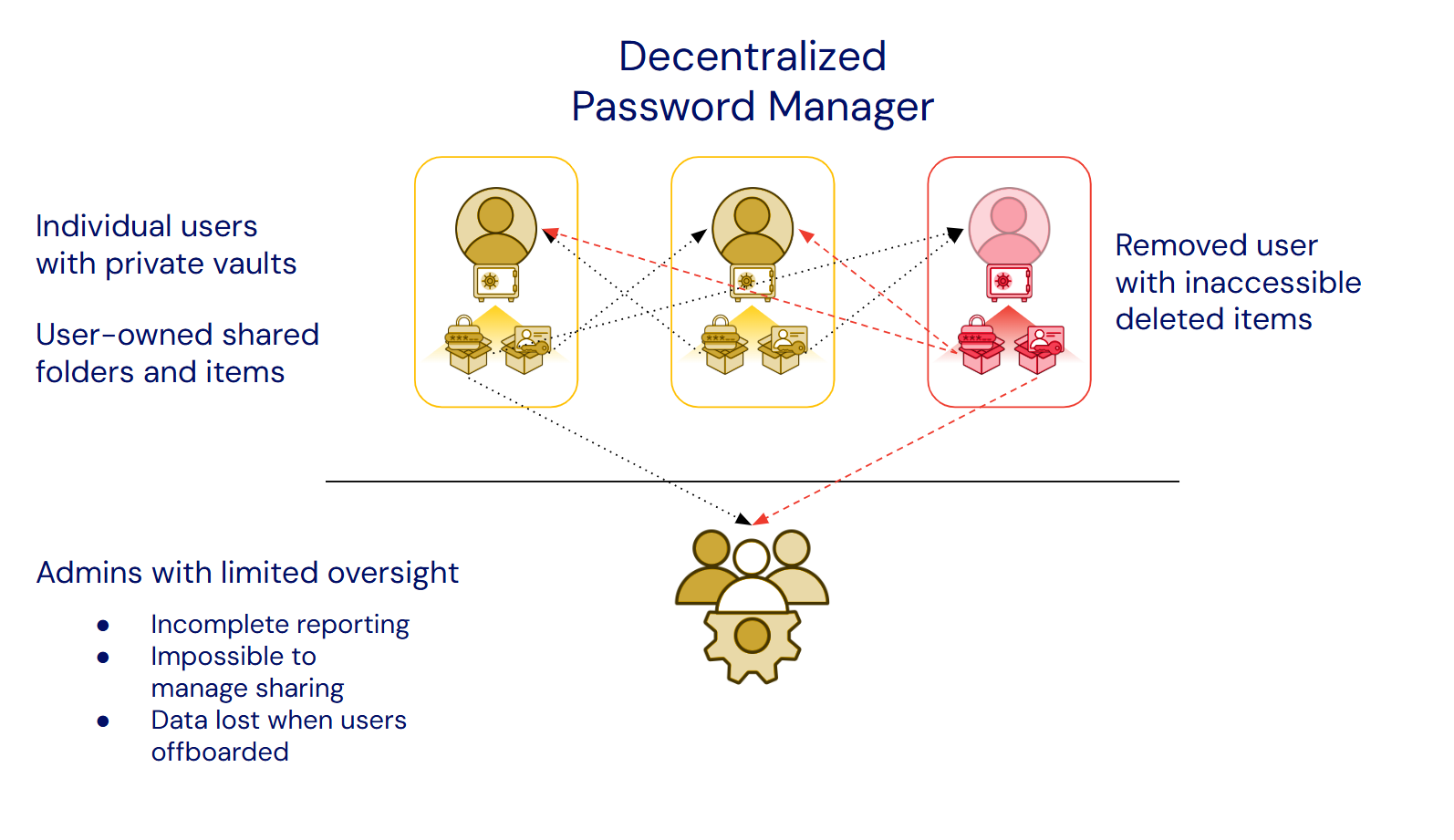
> These ownership gaps directly undermine Data Loss Prevention and business continuity principles, creating unnecessary risk and operational disruption.
✅ Complete organisational control
✅ Full reporting and risk insights
✅ Zero data loss when employees leave
Read the Bitwarden Security Perspectives
Read more about scalable password sharing and more in the Bitwarden Security Perspectives whitepaper series.
Bitwarden Security Perspectives:
Credential lifecycle management
Bitwarden was designed to help manage business needs at scale and provide complete credential lifecycle management. This is achieved through a centralised vault for all shared items and collections, which provide access control allowing for granular sharing with others. Every credential in the organisation vault is owned directly by the organisation, not individual employees. This offers many benefits, including clear reporting on credential access, easy recovery of deleted items, seamless employee transitions, and comprehensive audit trails for compliance.
TIP: Enterprise plans can enact a policy that requires all vault items, including unshared items, be stored in the organisation-owned vault. Learn more: Centralise organisation ownership
Other password management solutions were conceived as consumer-first products and focused on direct user-to-user sharing, without centralised oversight. This architectural difference now introduces challenges when supporting a business’s management needs at scale, resulting in processes that create a risk of data loss, complicate employee transitions, and make it impossible to maintain organisational control over business-critical credentials.
Having all credentials in an organisation-owned, centralised vault allows for intuitive management that eliminates ownership gaps. In Bitwarden:
All shared items belong to the organisation, not individual employees
The vault items exist independently of users or how they’re shared
This means that when an employee changes roles or leaves the company, credentials they shared remain safely in the organisation vault and are still available to team-mates. There's no need for complex vault transfers, account recoveries, or data loss concerns.
It also means that the organisation has oversight and control of the credential throughout its entire lifecycle, from when it is created to when it is retired. This ensures that full, auditable reporting of the item, including weaknesses and vulnerabilities, is available to the organisation's administrators.
The organisation maintains true ownership of business credentials. All shared items, access controls, and audit trails remain under organisational control.
Other password managers have created obstacles to centralised ownership and attempt to solve the gap in ways that are unintuitive and incomplete.
Workaround for other password managers | Description | The problem |
Policies to add admin access to folders | Attempt to recreate centralised ownership through a policy where admins are given access to new shared folders by default | ⚠️ Item owners can still delete shared items/folders without authorisation ⚠️ Personal vaults still exist outside admin view ⚠️ Requires complex configuration to set up |
Account recovery for offboarding / succession | When employees leave, their entire vault must be transferred to another user | ⚠️ Violates least privilege by giving another user access to items they shouldn’t ⚠️ Time-consuming and error-prone process ⚠️ May not be possible if the employee does not agree to the transfer |
Reporting “scores” | A health “score” is assigned to users to flag for admin review | ⚠️ Scores are meaningless and unhelpful ⚠️ Does not provide a complete picture of vault health |
Each of these methods is a poor substitute for an architecture designed for true organisational ownership.
If you don't have organisational ownership like with Bitwarden, it’s difficult to get a complete reporting picture on the health of stored credentials. Additionally, employee departures expose your business to data loss while adding significant workload to your IT team. These have real impacts on business operations and costs.
How other solutions increase risk
Malicious action disrupts business and cannot be easily reverted
Incomplete credential health reporting leaves weaknesses exposed
Possible data loss during staffing changes
Other solutions require more IT resources
Deep reporting requires admin legwork and time
Extra overhead pulls resources from other projects
Additional staffing may be needed for more admins or help desk support
Try it for yourself!
When evaluating password managers, check for these important attributes:
Are shared items owned by the company or by individual employees?
What happens to shared credentials when an employee leaves?
Can administrators control and manage all shared items?
How can an admin recover a deleted item?
Can an admin generate security reports on all credentials saved by users?