Deactivate My Browser's Built-in Password Manager
If you're new to Bitwarden, your web browser likely saves and autofills your passwords. Most web browsers enable this by default, even though experts generally agree that built-in password managers are more vulnerable than dedicated solutions like Bitwarden. We recommend turning off your browser's built-in password manager to improve your security and prevent interference with Bitwarden.
note
The Bitwarden browser extension can be deployed across managed endpoints. Learn more about deploying the Bitwarden browser extension to managed devices.
Manually disable a browser's built-in password manager
Learn how to disable the built-in password manager for major browsers.
tip
Several modern browsers, including Edge, Opera, and Brave, use a Google Chrome framework called "Chromium". If you are using one of those browsers, use the Chrome/Chromium instructions.
In Chrome or any Chromium-based browser (Opera, and Brave), navigate to the Passwords page by entering chrome://password-manager/settings in the address bar, substituting chrome for your browser name (for example, brave://password-manager/settings).
On this page, toggle off both the Offer to save passwords option and the Auto Sign-in option:

This page will also list any Saved Passwords that are being stored by the browser:

If you haven't already saved these passwords in Bitwarden, export them to prepare for future import to Bitwarden. Once exported, you should delete these passwords from the browser's storage.


Make Bitwarden your default password manager in Chrome
note
The Make Bitwarden your default password manager option is only available for the Chrome browser extension. For other browsers, manually disable their built-in password manager.
The Bitwarden browser extension on Chrome has a built-in setting to disable your browser's default password manager. To use this setting:
Navigate to the settings tab in the Bitwarden browser extension and then select Autofill.
Click to enable the Make Bitwarden your default password manager.
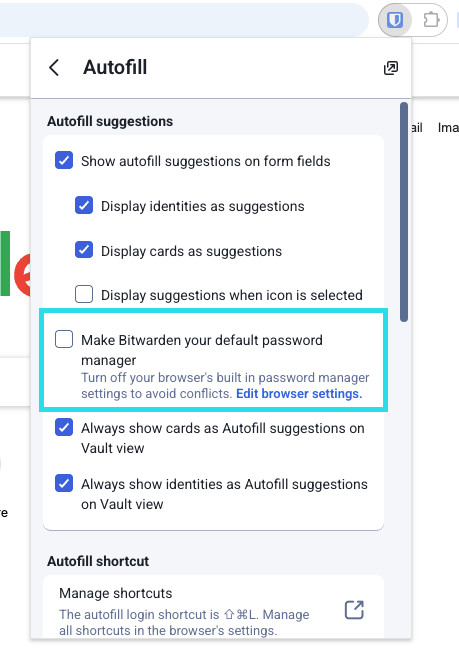
Make Bitwarden default password manager A dialogue will appear on screen, select allow to give Bitwarden permission to make changes to your browser settings.
